Intents
Organize your bot's knowledge using intents
What are intents?
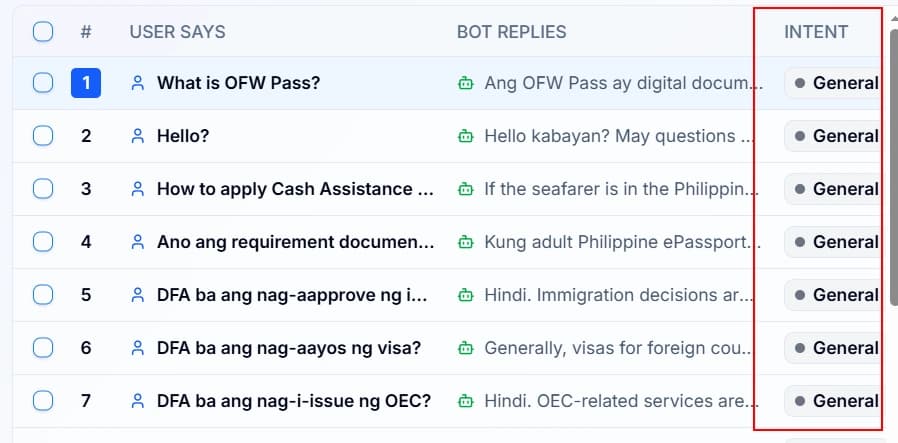
An intent is a way of grouping related information in your bot.
Think of an intent as a topic or purpose that a customer might ask about. For example, a store might have intents such as:
- Delivery
- Returns
- Payment Methods
- Order Status
- Store Locations
Each intent can contain multiple training pairs that cover different ways a customer might ask about that topic.
For example, the Delivery intent could contain questions such as:
- "How much is delivery?"
- "How long does shipping take?"
- "Do you deliver to Quezon City?"
- "What areas do you deliver to?"
This gives you a clearer way to organize related information.
Intents are for your team and do not change which answer your bot picks. Your bot chooses a training pair by its question, so if it gives the wrong answer, reword the pair's question instead of moving the pair to another intent.
Why use intents?
As your bot's knowledge grows, you may have hundreds or even thousands of training pairs. Keeping everything in one large collection can make it harder to organize and manage.
Intents give your training data structure.
They can help your by:
- Organize related information into meaningful groups.
- Find relevant information faster when editing data.
- Keep similar questions together so they are easier to manage.
- Maintain your training data as your bot grows.
Intents don't replace your training pairs. Instead, they provide a way to organize them.
How intents work
A training pair contains the information your bot uses to answer a question:
Question
Magkano ang delivery sa QC?
Answer
Delivery to Quezon City starts at ₱100.
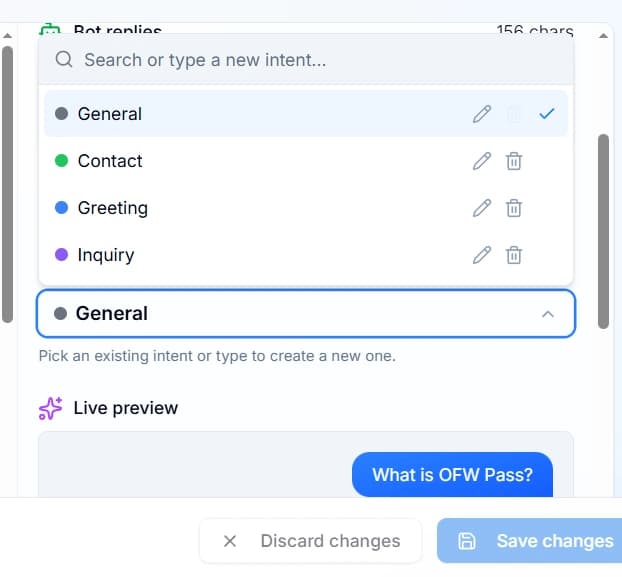
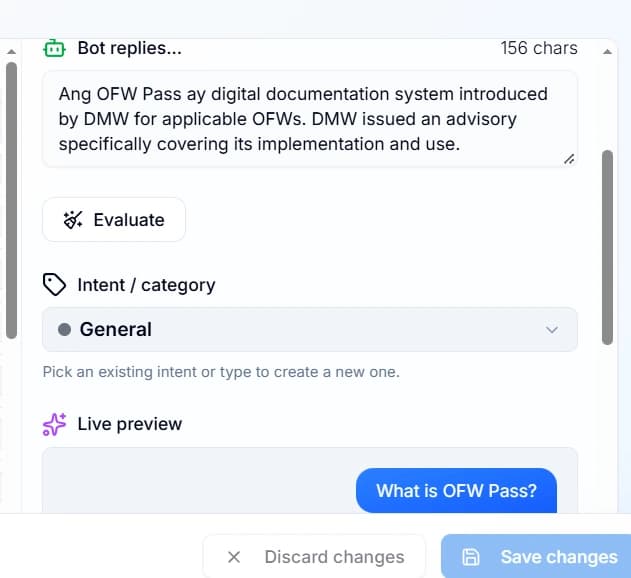
An intent gives that training pair a category:
Delivery
This means you can have multiple training pairs related to delivery without having to treat each one as completely separate information.
Create an intent
Create an intent that represents a specific topic or purpose.
Choose a name that clearly describes the type of information you plan to put inside it.
Review your intent
Check that the training pairs inside the intent are related to the same topic.
If a training pair covers a completely different subject, consider moving it to another intent.
Writing good intent names
Intent names should be simple and descriptive.
A good intent name tells you immediately what kind of information belongs inside it.
Good intent names
- Delivery
- Returns
- Order Status
- Payment Methods
- Product Availability
- Store Locations
Avoid overly specific names
You generally don't need an intent for every individual question.
For example, these intents would be unnecessarily specific:
- Delivery to Quezon City
- Delivery to Makati
- Delivery to Manila
Instead, you could use:
Delivery
and place the relevant training pairs inside it.
This keeps your training data easier to manage as you add more information.
Keep related information together
An intent should have a clear purpose.
For example, a Delivery intent could contain:
- Delivery fees
- Delivery areas
- Delivery times
- Shipping options
But a question about returning an item would belong in a Returns intent instead.
When an intent starts covering too many unrelated topics, consider splitting it into separate intents.
Intents and training pairs
Intents and training pairs work together.
An intent describes the broader topic, while a training pair provides the specific question and answer.
For example:
Intent: Delivery
| Question | Answer |
|---|---|
| How much is delivery? | Delivery starts at ₱100. |
| Do you deliver to QC? | Yes, we deliver to Quezon City. |
| How long does delivery take? | Delivery usually takes 2–3 business days. |
The intent keeps these related pieces of information together while each training pair handles a specific question.
Managing intents
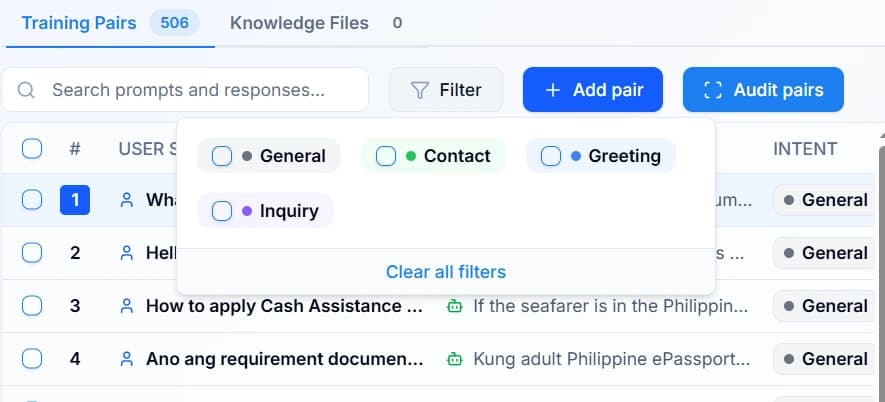
You can manage your intents from the side panel while working with your training pairs.
From there, you can organize your training data by creating, editing, or removing intents as your bot's knowledge changes.
As your bot grows, periodically reviewing your intents can help keep your pairs organized and easier to maintain.
You may also want to check out these guides
| Training Pairs | Learn how to create effective questions and answers |
| Knowledge Files | Train your bot using your own files |
| Playground | Test your bot's new data |
| Inbox | See how your bot interacts with users |
Did this fix it?
If you are unable to solve your issue, tell us what happened. You do not need to be signed in.